To my utter astonishment and amusement, I was recently emailed by Forman & Field (the online gourmet shop that specialises in independent producers) who had read my blog and wondered if I'd review some of their smoked salmon if they sent a pack of their 'London Cure' to me. Being deeply cynical 'where's the catch' was my immediate reaction followed by 'what if I don't like it?'. Greed outweighed such silly concerns and so a package was promptly dispatched.
I rarely buy smoked salmon for myself and so to receive a pack of 'H. Forman & Son London Cure Smoked Scottish Salmon' was a real treat. According to the packaging, Formans are the oldest salmon smoker in Britain, started in 1905. They claim that their London Cure is one of the most delicate as the idea is to taste the salmon, not the smoke. They also recommend that one doesn't serve the salmon with lemon as it disguises the fish's natural flavour.
So, what should one serve it with? I took Formans' advice and had my first slice unadorned. The fish had a rich, silky texture and melted beautifully on my tongue. Although it was far from cloying, I decided that I personally needed a touch of acidity to cut through the richness of the fish. It certainly wasn't the smokiest fish I'd ever tasted but instead had a sweet character that was akin to chestnuts and peat.
Formans' generous gift saw me through two meals. The first, a simple open sandwich (on a gluten free roll) accompanied by a simple salad including my favourite broad beans with a drizzle of lime juice.
The lime was a touch too far and so I experimented with alternative sources of acidity and arrived at an elegant solution of preserved lemons, dill, capers and mere touch of Dijon mustard which I mixed with prawns, peas and beans and served with the final slices of salmon, nestled on a bed of finest English round lettuce. Springtime on a plate.
Personally I like a touch of zing and so sorry H. Forman & Sons - this sampler will continue to add lemon (albeit in the preserved, salty form). So, the overall verdict? Lovely texture, gorgeous natural colour and subtle sweet flavour and very rich. Not to be eaten everyday but then it wouldn't be such a treat, now would it?!
Showing posts with label Fish and Seafood; Gluten and Dairy Free. Show all posts
Saturday, April 16, 2011
Monday, February 22, 2010
Fish Pie
Living alone has rendered me somewhat of a lazy cook, as demonstrated by my lack of posts. I rarely take the time and care to create something overly tempting or complicated for myself, and I certainly never try new recipes out if they are only to feed one. I was delighted therefore to have an opportunity to try a twist on an old favourite for two very dear friends. It was a terribly wet and cold evening and so a warming but informal fish pie was the perfect dish - and something that I would not go to the bother of making for just me. The whole process, from selecting ingredients, to skinning fish whilst my dear friend Peter mashed celeriac, warmed my soul and reminded me just how much I relish the challenge of adapting recipes and nurturing others by providing a meal.
Fish Pie (serves four) adapted from Sophie Dahl's recipe in December's Observer Food Monthly
for the topping
1 large celeriac
milk
salt and pepper
for the pie
700-800g fish fillets (I used a mixture of undyed smoked haddock and pollack)
200g large, cooked and peeled prawns
600ml milk
2 bay leaves
four black peppercorns
olive oil
one small onion, chopped
2 leeks, white part only, finely chopped
handful of peas, defrosted if frozen
3tbs chopped flat-leaf parsley
1 1/2 tbp soya margarine (or butter)
3tbsp cornflour or arrowroot
white wine
1. Peel the celeriac and cut into chunks. Boil under tender.
2. Drain, return to the pan with a splash of milk and mash with vigour (you can use a blender if you prefer a smoother topping). Season and set aside.
3. Preheat your oven to 200C.
3. Place the fish in a large, flat pan, cover with milk. Add the bay leaves and peppercorns. Poach for four minutes (you may need to do this in two batches). Remove the fish, pour the milk into a jug. When the fish is cool, remove any skin and check for bones, flaking the fish with your hands as you go. Rinse the prawns and add them to your fishy mix.
4. Heat a splash of oil in a frying pan and sweat the onion and leeks without allowing them to catch and go brown. When soft, remove from the heat and stir in the peas and parsley.
5. In a large pan, melt the margarine on a low heat and stir in the cornflour or arrowroot mixed with a little of the milk to make a paste. Slowly pour in the rest of the milk and increase the heat whilst continually stirring until you have a thick sauce. Add the fish, vegetable mix and a good slug of white wine. Season (go steady on the salt).
6. Pour the mixture into a deep baking dish. Cover with the celeriac mash.
7. Pop in the oven for 20 minutes.
And perhaps it's about time that I started to nurture myself a little more frequently. Hmmm.
Fish Pie (serves four) adapted from Sophie Dahl's recipe in December's Observer Food Monthly
for the topping
1 large celeriac
milk
salt and pepper
for the pie
700-800g fish fillets (I used a mixture of undyed smoked haddock and pollack)
200g large, cooked and peeled prawns
600ml milk
2 bay leaves
four black peppercorns
olive oil
one small onion, chopped
2 leeks, white part only, finely chopped
handful of peas, defrosted if frozen
3tbs chopped flat-leaf parsley
1 1/2 tbp soya margarine (or butter)
3tbsp cornflour or arrowroot
1. Peel the celeriac and cut into chunks. Boil under tender.
2. Drain, return to the pan with a splash of milk and mash with vigour (you can use a blender if you prefer a smoother topping). Season and set aside.
3. Preheat your oven to 200C.
3. Place the fish in a large, flat pan, cover with milk. Add the bay leaves and peppercorns. Poach for four minutes (you may need to do this in two batches). Remove the fish, pour the milk into a jug. When the fish is cool, remove any skin and check for bones, flaking the fish with your hands as you go. Rinse the prawns and add them to your fishy mix.
4. Heat a splash of oil in a frying pan and sweat the onion and leeks without allowing them to catch and go brown. When soft, remove from the heat and stir in the peas and parsley.
5. In a large pan, melt the margarine on a low heat and stir in the cornflour or arrowroot mixed with a little of the milk to make a paste. Slowly pour in the rest of the milk and increase the heat whilst continually stirring until you have a thick sauce. Add the fish, vegetable mix and a good slug of white wine. Season (go steady on the salt).
6. Pour the mixture into a deep baking dish. Cover with the celeriac mash.
And perhaps it's about time that I started to nurture myself a little more frequently. Hmmm.
Monday, July 07, 2008
Balls! Spicy Fish Ones
Think balls in London in July and most people tend to think of Wimbledon. I however think of these delicious little morsels which I made for supper with one of my most beloved friends who loves all things fishy. http://newmanlegros.blogspot.com
The recipe is adapted from the super 'Steam Cuisine' by Marina Filippelli. It is uber healthy thanks to the method of cooking and is naturally gluten and dairy free.
Spicy Fish Balls serves 2 (with leftovers)
1 red chilli, seeded
1 garlic clove
nub of fresh ginger, peeled
handful of fresh coriander
1tsp cornflour
1/4tsp salt
1/4tsp caster sugar
300g white fish fillets, skinned
1/2tbsp tamari (or soy) sauce
1/2tsp sesame oil
1/2 medium egg
Put chilli, garlic, ginger and coriander in a food processor. Add cornflour, salt and sugar and whizz until finely chopped.
Feel the fish and remove any bones. Add to the processor with the tamari sauce, sesame oil and egg and whizz again until well blended.
Using wet hands, shape into 10 or so balls the size of large walnuts.
Cover with cling film and leave in the fridge for 30 minutes or over night.
Bring the water in your steamer to the boil.
Line the steamer with baking parchment and pop the fish balls inside. Steam for 4-5 minutes until they feel firm.
I served with jasmine rice, lime wedges and a cucumber, carrot and chilli salad.
Ballsy!
Sunday, December 03, 2006
Mother's Ruin?
It has been an awfully long time since my last food blog, for no other reasons than I am trying to restrain the ramblings on my personal life elsewhere and that my newly acquired single-status does not lead to the most scintillating of sensory overloads. As yet.
However last night I had a rare opportunity to cook, and not just for anyone, but for someone I love. My mother.
The older I get, the more I appreciate my parents and I increasingly relish the tastes and pleasures in which we share. And for mum and I, one of these little joys has to be the fragrant and heady flavours of gin. Dubbed 'mother's ruin' for a whole host of reasons in the 18th century (on which I can bore for Britain, my specialist degree subject bizarrely encompassed such matters - a hint is the works of Hogarth), I am happy to reveal that my mother and I find that gin, rather than ruining an evening, tends to enhance it.
The situation for our happy reunion is immaterial, suffice to say we found ourselves alone, in an alien kitchen with salmon fillets, a bottle of gin, sparse store-cupboard goodies and a camera on its last legs (hence the dirth of images). Mother's ruin? More like Mother's Success.
Tipsy Salmon (for a tipsy mother/daughter combination)
olive oil
2 leeks - washed and finely sliced
1 garlic clove, finely sliced
juice of half a lemon
gin
bay leaf
flat-leaf parsley, finely chopped
two salmon fillets
Preheat the oven to 180-200 centigrade.
Put the leeks, garlic, bay leaf and parsley in a shallow oven-proof dish. Sprinkle over a good glug of olive oil, lemon juice and a sizeable glug of gin. Season and cover with tin foil. Pop into the oven for approx 20 minutes, turning at least once. When the leeks are soft, nestle the salmon fillets on top of the leeks (skin down), re-cover with foil and cook for approx 15-2o minutes depending on how well one likes one's salmon cooked. Baste at least once during cooking time to prevent the fish dying out, adding more gin/lemon juice or even a splash of apple juice if necessary.
Enjoy with steamed greens, possibly jasmine rice, but certainly with one's mother.
However last night I had a rare opportunity to cook, and not just for anyone, but for someone I love. My mother.
The older I get, the more I appreciate my parents and I increasingly relish the tastes and pleasures in which we share. And for mum and I, one of these little joys has to be the fragrant and heady flavours of gin. Dubbed 'mother's ruin' for a whole host of reasons in the 18th century (on which I can bore for Britain, my specialist degree subject bizarrely encompassed such matters - a hint is the works of Hogarth), I am happy to reveal that my mother and I find that gin, rather than ruining an evening, tends to enhance it.
The situation for our happy reunion is immaterial, suffice to say we found ourselves alone, in an alien kitchen with salmon fillets, a bottle of gin, sparse store-cupboard goodies and a camera on its last legs (hence the dirth of images). Mother's ruin? More like Mother's Success.
Tipsy Salmon (for a tipsy mother/daughter combination)
olive oil
2 leeks - washed and finely sliced
1 garlic clove, finely sliced
juice of half a lemon
gin
bay leaf
flat-leaf parsley, finely chopped
two salmon fillets
Preheat the oven to 180-200 centigrade.
Put the leeks, garlic, bay leaf and parsley in a shallow oven-proof dish. Sprinkle over a good glug of olive oil, lemon juice and a sizeable glug of gin. Season and cover with tin foil. Pop into the oven for approx 20 minutes, turning at least once. When the leeks are soft, nestle the salmon fillets on top of the leeks (skin down), re-cover with foil and cook for approx 15-2o minutes depending on how well one likes one's salmon cooked. Baste at least once during cooking time to prevent the fish dying out, adding more gin/lemon juice or even a splash of apple juice if necessary.
Enjoy with steamed greens, possibly jasmine rice, but certainly with one's mother.
Friday, October 27, 2006
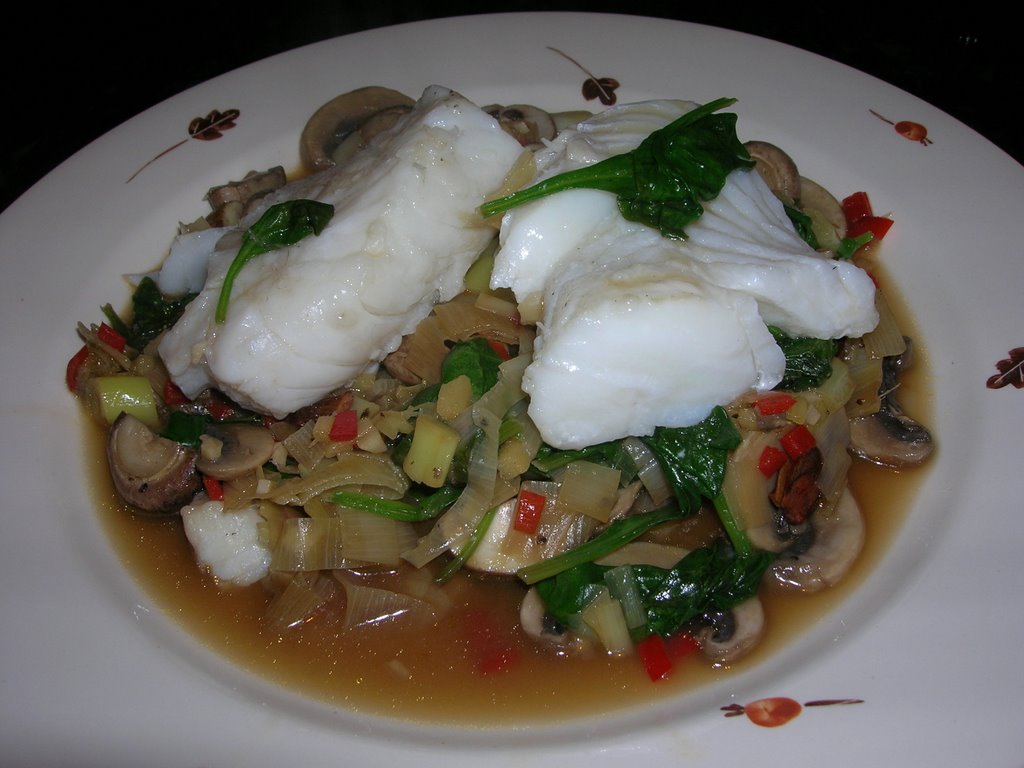
Comforting Cod

I am beginning to find my groove, such as it is, for now. I won't bore you with it here (if you're really interested you can always visit my other non-foodie blog) but I am finally learning that nourishing one's self - one's emotions, self-esteem, home and ultimately, one's appetite - is a recipe for contentment and one which should be encouraged rather than one in which to find guilt.
And so, in order to guard off a threatening cold (hence the ginger, garlic and chili) and to celebrate the opportunity for a candle-lit dinner for one I concocted the following simple, but soul-warming dish.
Comforting Cod
(yes, you guessed it, serves one gorgeous blonde)
sesame oil
2 cloves garlic, finely sliced
1 red chili, deseeded and finely sliced
'thumb' of ginger, peeled and finely chopped
star anis
1 leek, washed and finely sliced
150g crimini mushrooms, wiped clean (halve or even quarter the large ones)
sherry
nam pla (fish sauce)
tamari (or soy sauce - tamari has a meatier taste and just loves fungi - but then don't we all love a chap with a sense of humour?!)
handful of baby spinach leaves
1 cod fillet
Heat a good slug of sesame oil in a large frying pan to which you have the lid. Once warmed add the garlic, chili and ginger and muddle about for a few minutes.
Add the leek, cover and sweat, check occasionally that the leeks are not sticking to the pan. Trickle sherry in as and when necessary to avoid this and to create a shallow pool of liquor. Throw in a few petals of dried star anis.
After around 10 minutes when the leeks have lost their rubbery quality and softened to a baby's breath, add the mushrooms, a good shaking of both the nam pla and tamari and pop the lid back on the pan.
After around five to ten minutes throw in a handful of spinach leaves, another glug of sherry and replace the lid.
Sit the cod fillet on top of the vegetable tangle, replace the pan lid and allow the fish to gently steam for approx. five to ten minutes (depending on thickness of fillet and how well done you like your fish to be).
Remove the fish and serve the vegetable melange on a plate and then pop the fish on top.
I am aware the portion in the photo looks enormous and quite frankly, it was rather large! However as I don't tend to eat carbs (for no other reason than my odd stomach doesn't like them and that this morning I succumbed to the hi-tech weighing machine at the gym and am apparently a bit of a light weight with a BMI of just 19), I really don't care! As I said, it's about nourishing one's soul. Lemony or otherwise.
Monday, October 02, 2006
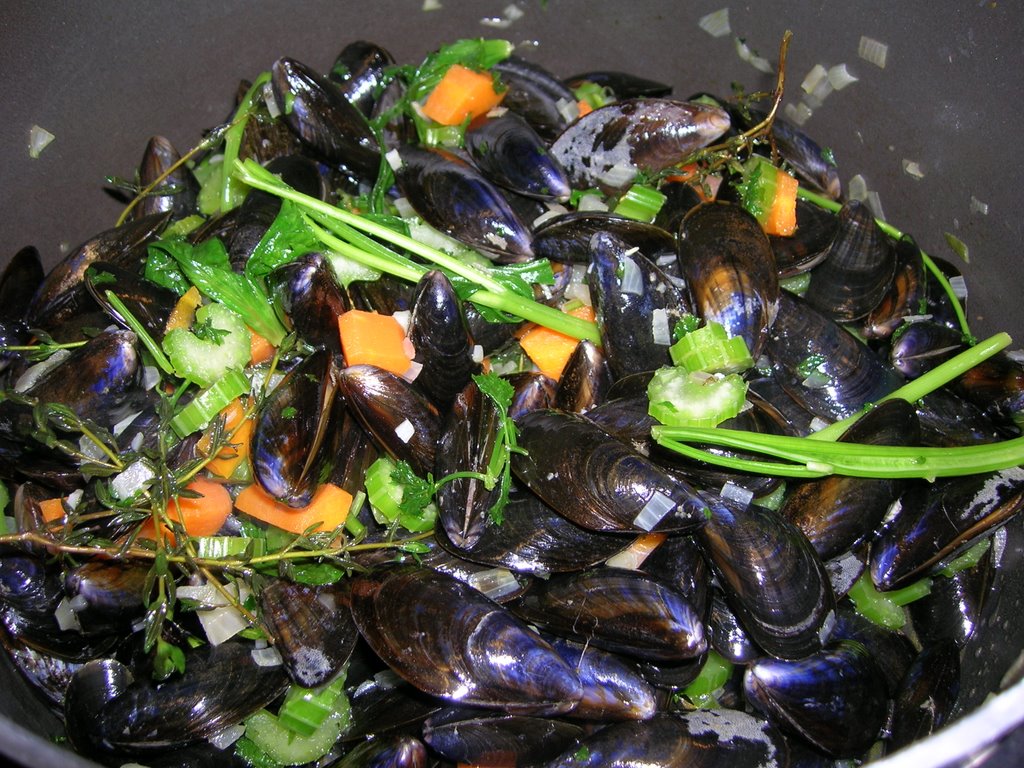
Moules Lillois
Yesterday I returned from a long-weekend in Lille, the capital of Flanders and home to one of my most wonderful friends and his loving partner. We shared recipes, discussed politics, food and love and bathed in the warm glow of deep friendship. A truly lovely weekend and one that has helped to restore my spirit. And my passion for creating recipes.Peter has not eaten meat for nearly twenty years and is a brilliant cook of all dishes pescatarian. He concentrates on a one or two key quality ingredients at each meal and creates simple but beautifully orchestrated food.
I have never cooked mussels, being rather nervous of their barnacles and fearful of poisoning myself or others if the little blighters choose not to open. Peter however is fearless and far more sensible than me and so he executed a vibrantly freshly flavoured version of moules marinieres which we christened Moules Lillois.
Moules Lillois (serves three to four)
2kg fresh mussels
2 shallots, peeled and finely chopped
3 or 4 stems of celery (depending on their thickness), diced
2 cloves of garlic, peeled and finely chopped
1 carrot, peeled and finely diced
3 or 4 sprigs of thyme
200ml white wine
200ml water
Large sprig of parsley, chopped
Wash the mussels, scrape off any lingering barnacles and discard those that are open or cracked.
Fry the shallots, celery and garlic in olive oil until they soften. Add the carrot and fry for a few more minutes. Add the thyme, wine and water and raise the heat so that the liquid simmers. Add a good grinding of black pepper. Throw in the mussels and cook for four to five minutes until their shells have opened and the flesh is a tender orange in colour.
Remove from the heat and serve into large bowls with the liquor, removing any shells that failed to open. Sprinkle with the parsley and serve.
Uncomplicated and truly delicious. There is a lot to be said to such an approach to food.
For more about Peter and his move to France, visit Le Log Lillois at http://newmanlegros.blogspot.com
Subscribe to:
Posts (Atom)


.jpg)